| Author |
Message |
labelchanger
Guest
Free account, no CAN development support
|
 11-04-2012, 17:53 Subject: CAN Bus Resistors: Troubleshooting & Best Practices 11-04-2012, 17:53 Subject: CAN Bus Resistors: Troubleshooting & Best Practices |
Quote |
|
Hello everyone,
I bought a CAN232 adapter two years ago and successfully got it working, but then I stopped researching further due to lack of time.
Now I'm getting back into the subject matter.
When I reviewed the specifications for the Lawicel, I noticed that it requires 120 Ohm resistors to be installed on both the CAN-L and CAN-H lines.
What are they for?
Because I hadn't installed them on my self-built radio adapter, and it still worked. However, I had also briefly run the interface while the vehicle was stationary.
I simply tapped into the radio's power and data pins on the ISO connector using a Y-connector for the CAN-L and CAN-H lines, connecting them to the radio connector and soldering them to the RS232 connector, which was then connected to the Lawicel interface, and it all worked fine.
But what are the resistors actually needed for?
Thank you in advance for your replies, and best regards.
LC.
Translated on 29-07-2026, 8:31.
|
|
| Back to top |
|
 |
CAN-Diagnose
Administrator


Joined: 06/07/2011
Posts: 575
Karma: +29 / -0 
Location: Ländle
|
| 11-04-2012, 18:33 Subject: CAN Bus Resistors: Troubleshooting & Best Practices |
Quote |
|
Hello,
The resistors without the letter "e" are used to prevent signal reflections on the bus.
Best regards, Rainer.
Last edited on 11-04-2012, 18:33, edited 1 time in total.
|
|
| Back to top |
Profile PM WWW |
|
labelchanger
Guest
Free account, no CAN development support
|
| 12-04-2012, 0:06 Subject: CAN Bus Resistors: Troubleshooting & Best Practices |
Quote |
|
Thank you for your reply, Rainer.
If I understand correctly, you should adjust the termination resistors 'quickly.'
now without the letter 'e' ... Thank you for the suggestion  to include a mechanism in my adapter to prevent data loss.
I haven't had any problems eavesdropping so far (is that possible?).
If I understand the circuit diagram 'http://www.can232.com/products.htm' correctly, I need to install one resistor directly between the CAN-Low and CAN-High cables, and another directly behind it, also between CAN-Low and CAN-High.
'I'm not entirely clear on the setup. If I connect both lines with 120-ohm resistors each, wouldn't that result in 240 ohms per CAN line? Am I misunderstanding something? Why don't they simply add 240-ohm resistors in series to each CAN line?'
Best regards,
LC.
Translated on 29-07-2026, 8:35.
|
|
| Back to top |
|
|
reieg99
Guest
Free account, no CAN development support
|
| 12-04-2012, 10:51 Subject: CAN Bus Resistors: Troubleshooting & Best Practices |
Quote |
|
Thank you for your answer, Rainer.
If I understand correctly, you should adjust the termination resistors 'quickly.'
now without the letter 'e' ... Thank you for the suggestion to include a mechanism in my adapter to prevent data loss.
LC
No, the termination resistors are only required at the 'start' and 'end' of the bus. Since you are only monitoring the signal, the bus is already terminated, so you do not need any resistors. In fact, you should not install any additional resistors.
Regards,
Andi.
Translated on 29-07-2026, 8:37.
|
|
| Back to top |
|
|
Dieselfahrer
CAN-Profi

Joined: 07/28/2011
Posts: 79
Karma: +6 / -0
CAN Support
|
| 12-04-2012, 12:42 Subject: CAN Bus Resistors: Troubleshooting & Best Practices |
Quote |
|
reieg99 wrote: | labelchanger wrote: | Thank you for your answer, Rainer.
If I understand correctly, you should adjust the termination resistors "quickly."
now without the letter "e" ... Thank you for the suggestion to include a mechanism in my adapter to prevent data loss.
LC |
No, the termination resistors are only required at the "start" and "end" of the bus. Since you are only reading data from the bus, it is already terminated, so you do not need any resistors. In fact, you must not install any additional resistors. |
Basically, completely correct.
However, the termination resistor is not always present at each of the two "ends" of the CAN bus in a vehicle, and this is often because the "bus" frequently has more than two ends – it's structured like a tree.
You can find more details here, for example:
SSP269 (Self-Study Program from Volkswagen).
under "Specifics of the Corporate CAN Bus" (also interesting for those who modify vehicles other than VW).
Best regards,
Ingo
Translated on 29-07-2026, 8:39.
|
|
| Back to top |
Profile PM |
|
labelchanger
Guest
Free account, no CAN development support
|
| 12-04-2012, 15:14 Subject: CAN Bus Resistors: Troubleshooting & Best Practices |
Quote |
|
OK, thank you for your answers.
Then I won't install the resistors if I only want to read/listen.
I don't have to 'freshen up' my adapter again .
But if I ever want to write and read data on the bus, should I use resistors?
You probably already noticed, but I still haven't quite grasped the concept of resistors.
I took the CAN-L and CAN-H lines directly from the radio. However, since I no longer have the factory radio installed, the termination should be completely missing.
Therefore, the error memory in VCDS always immediately displays...
'There's a fault in the 01305 data bus for the infotainment system. After I deactivated the radio, the bus error disappeared, but of course, no signals are coming through the CAN bus anymore, so now I have to live with this issue.'
Could someone please explain to me again when and why resistors are needed?
Best regards,
LC.
| Description: |
|
| File size: |
192.36 KB |
| Viewed: |
9257 times |
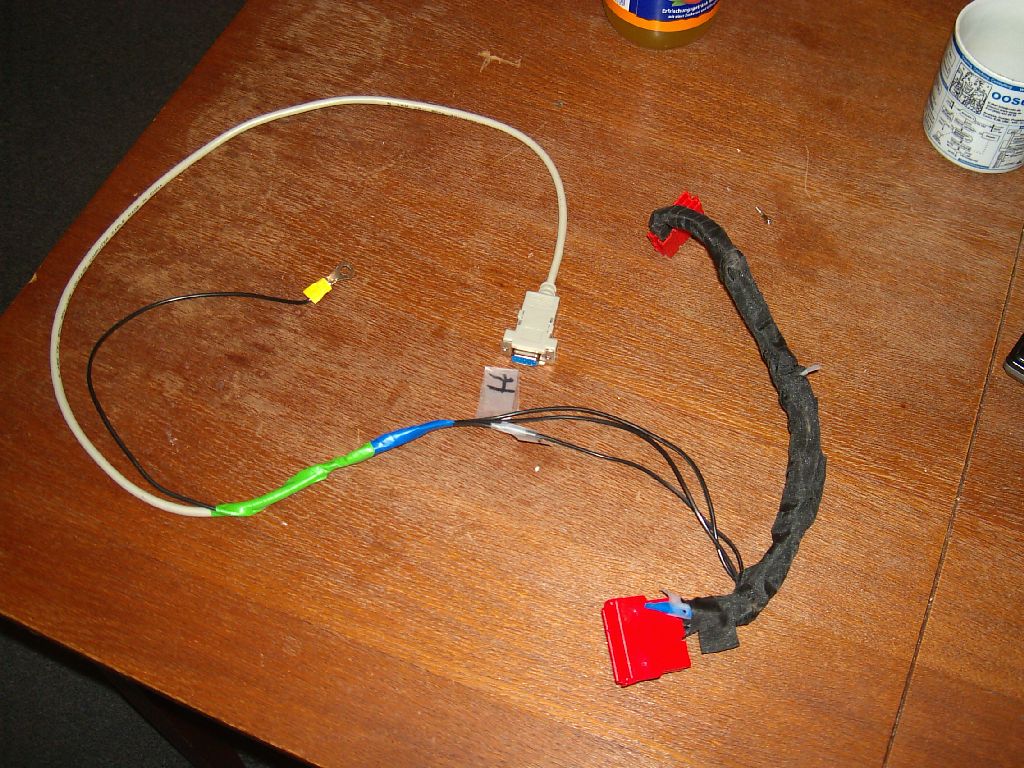
|
Translated on 29-07-2026, 8:42.
|
|
| Back to top |
|
|
Dieselfahrer
CAN-Profi
Joined: 07/28/2011
Posts: 79
Karma: +6 / -0
CAN Support
|
| 12-04-2012, 20:59 Subject: CAN Bus Resistors: Troubleshooting & Best Practices |
Quote |
|
Quote: | OK, thank you for your answers.
Then I won't install the resistors if I only want to read/listen.
I don't have to "freshen up" my adapter again .
But if I ever want to write and read data on the | BUS Quote: | | , should I use resistors or something else? |
No. If the bus is already fully populated – meaning all its lines are used – you never need to add any additional resistors.
Quote: | You probably already noticed, but I still haven't quite grasped the concept of resistors.
I took the CAN-L and CAN-H lines directly from before the radio. However, since I no longer have the factory radio installed, the termination should be completely missing. |
If the radio is located at the rear of the bus and contains a 120-ohm resistor, you would need to connect another one there as well – although this is unlikely. Just check the SSP (Service Security Protocol) document that I linked to see if it mentions anything about this.
Quote: | That's why the error memory in VCDS always immediately shows...
There is an error in the 01305 data bus infotainment system. |
It probably says "no communication" because the gateway isn't receiving a response from the radio. However, that doesn't necessarily mean there's a problem with the bus itself.
Quote: | | Once I had decoded the radio, the BUS error disappeared, but as a logical consequence, no signals were received via the CAN bus anymore, so now I have to live with the error. |
Okay. If the gateway thinks there's no radio present, it won't send anything to the radio and also won't expect a response.
Why don't you just join in and listen to the radio for a while?
http://de.wikipedia.org/wiki/LeitungstheorieSo, could someone please explain to me again when and why resistors are needed?}
If you really want to know why, then you need to study leadership theory; unfortunately, that's the only way.
}
Best regards,
Ingo
Translated on 29-07-2026, 8:46.
|
|
| Back to top |
Profile PM |
|
labelchanger
Guest
Free account, no CAN development support
|
| 16-04-2012, 12:22 Subject: CAN Bus Resistors: Troubleshooting & Best Practices |
Quote |
|
@Diesel drivers
Okay, thanks for the information. Best regards.
LC.
Translated on 29-07-2026, 8:49.
|
|
| Back to top |
|
|
Ulli13
Joined: 10/08/2012
Posts: 27
Karma: +19 / -0
Location: Senden
2018 Audi A4 Avant
CAN Support
CAN-Diagnose likes this. |
| 01-05-2016, 17:31 Subject: CAN Bus 60 Ohm Termination Resistor |
Quote |
|
The conclusion at the high-speed CAN should be...
Every CAN bus line must be terminated with a 60-ohm resistor.
It can be easily measured with an ohmmeter when it is in an inactive state.
There are several ways to achieve a resistance of 60 ohms.
"With 2 STG (Signal Transceivers), each has a built-in 120 Ohm resistor, resulting in a total of 60 Ohms."
2. In a star configuration, there is a center point with a 60-ohm impedance, and all branches have no resistors installed.
3. Long CAN with 2 termination resistors of 120 ohms (60 ohms each), all stages without resistance, e.g., in our Setra bus system.
4. Gateway from one control unit to the vehicle: In this case, a single CAN bus is used, so it's necessary to terminate with a 60 Ohm resistor between the control unit and the CAN controller.
Best regards,
Uli
Audi A4 B9 Bj 2018
Translated on 29-07-2026, 8:50.
|
|
| Back to top |
Profile PM Email Garage |
|
|


 Bookmarks
 Garage
 FAQ, Legal Notice & Privacy
 RSS Feed
 Register
 Login
Login
